Flotsam
illustrated by David Wiesner
Clarion, 2006. 40 pgs.
Reading Level: ages 4-8
Hardcover: $17.00
Annotation: When a camera washes up on the beach, the mysteries of the ocean are revealed in a most surprising way.
Summary: At the beach, a young boy is examining the bugs, crabs and other sand creatures when a huge wave deposits an old camera on the shore. The yellow-haired boy tries to find the owner to this mysterious underwater camera, but to no avail and so he takes the film to be developed. When the pictures are finally ready he discovers a world he never knew existed. The photos reveal all the magic that happens underneath the ocean's surface. He sees pictures of mechanical fish, octupuses sitting in living rooms reading books, turtles with whole towns made of shells on their backs and even little green men riding fish and meeting seahorses. But then he makes the most amazing discovery of all. He finds a picture of an Asian girl holding a picture of another boy, holding a picture of a girl who is holding the picture of yet another child! As he uses his magnifying glass he discovers the pictures date back far back in the past. Children from all over the world have been using this camera to take pictures of themselves and then sending the camera back to the sea for another child to uncover and discover the wonders of the ocean. The yellow-haired boy holds up the picture of the girl, snaps a picture of himself and then throws the camera back into the ocean, where it is found by a stingray and carried by seahorses to be discovered by another lucky child in the future.
Evaluation: Told strictly through illustration, Flotsam takes the reader on a magical journey through the wonders and mysteries of oceanlife. Weisner's imagination is deliciously fantastical as he creates a world where merpeople have fish named Spot (due to their spots of course) and ride on stingrays through the lampost lit jungle of the ocean floor. There is a combination of the real and the imaginary that delights the senses and turns the sometimes scary ocean into a place of thrilling discovery. The story is ever so clever and the images are bright and playful. The illustrations mirror the book's theme, being set in black-rimmed squares and rectangles, just like a photograph. Weisner's mode of storytelling, wherein children discover the camera and photograph themselves holding photos of other children, is ingenious and the book is simply irresistable. I am in complete and utter love with this book and proclaim it absolutely and undeniably worthy of being a Caldecott winner. Weisner is no newcomer to the Caldecott and he has several winners and honors to his name and his books have been translated in over a dozen languages. However, he excels in wordless storytelling, where translation is unnecessary and Flotsam is a book that any child, anywhere can appreciate.
Significance: This title introduces readers to the mystery and magic of what lies beneath the ocean's waves. The ocean can be a scary place when you're unable to see what's happening, but Weisner offers an explanation of underwater life that wipes away the fear and creates a safe, playful interpretation instead. Whether it's absolutely true or not is just part of what makes the ocean so fascinating. With a little imagination, anything can be true.
Personal Choice: I was utterly enchanted by the deep red background cover, schools of tiny fish swimming by and the ever so mysterious porthole eye right in the center. As always, you shouldn't judge a book by its cover, but if it's a picture book, than you have to, right?
Awards: Caldecott Award Winner, 2007 / ABA - Book Sense Book of the Year: Illustration Honor, 2007
Always read something that will make you look good if you die in the middle of it. ~P.J. O'Rourke
Monday, March 28, 2011
Strega Nona
Strega Nona
written and illustrated by Tomie de Paola
Simon & Schuster, 1975. 32 pgs.
Reading Level: ages 4-8
Hardcover: $18.99
Annotation: When Big Anthony uses Strega Nona's magical pasta pot the whole town becomes endangered.
Summary: In the tiny Italian village of Calabria, Strega Nona (Grandma Witch) performed all sorts of magical potions for the villagers, but Strega Nona was getting old in need of someone to help her with her house and garden. Big Anthony applied for the job and did fine work, but Strega Nona warned him never to touch her big pot. One day Big Anthony spied Strega Nona making pasta in her pot from the window. Strega Nona sang a song and the pot began making pasta all be itself, then she sang another song and the pot stopped, providing just enough past for Strega Nona. It was magic! Big Anthony was delighted. One day Strega Nona had to travel to a neighboring village and as she departed, she warned Big Anthony not to touch her big pot. But Big Anthony did not obey and as soon as she left he sang the song and sure enough, the pasta started growing like magic. When he had enough, he sang the song to make the pot stop cooking, but he had not seen Strega Nona blow three kisses that day he spied on her through the window. The pasta kept growing, and growing and growing and growing until the entire village was overrun with the thick strands of pasta. Horrified, Big Anthony kept singing the song to make the pasta pot stop, but to his frustration it would not work without the three kisses he had never seen Strega Nona deliver. As the village was about to be destroyed, Strega Nona appeared and realized what Big Anthony had done. She immediately sang the magic song, blew three kisses and the village was saved. But, Big Anthony got in very big trouble and Strega Nona made sure his punishment fit the crime.
Evaluation: De Paolo does a fantastic job turning this Italian folktale into a charming story that readers in the present day continue to enjoy. His illustration style relies heavily on folkart and thus the tale and the illustrations complement each other perfectly. The images are subdued, a bit simple, but so engaging. I love how the strands of pasta curve and wind thickly around the villagers homes and belongings. De Paolo is spare in the illustration details, but if you look closely, the expression on Strega Nona's face as she returns to her village overrun with pasta is priceless. As one reader relay's, "it is a fun blend of magic, fantasy and adolescent mischief". I have to agree. This title is a classic tale, ever popular and undenyingly relevant, despite it's having been published in the 70's. With a strong moral and excellent drawings, this title should remain a hit for years to come.
Significance: Big Anthony learns there is often a very good reason you are told not to do something and when he chooses to defy the rules he is forced to pay a high price for his disobedience.
Personal Choice: I learned this was one of de Paolo's most beloved books when I was reading about the Wilder award and I had to see what all the fuss was about. I found out it was published the year I was born! Shhh, don't tell--now it has a very special place in my heart.
Awards: Wilder Winner, 2011 / Caldecott Honor Award, 1976 / ALA Notable Children's Book / Kirkus Choice / Horn Book Honor List / Nakamori Prize / Brooklyn Museum & Public Library Art Books for Children Citation (N.Y.)
written and illustrated by Tomie de Paola
Simon & Schuster, 1975. 32 pgs.
Reading Level: ages 4-8
Hardcover: $18.99
Annotation: When Big Anthony uses Strega Nona's magical pasta pot the whole town becomes endangered.
Summary: In the tiny Italian village of Calabria, Strega Nona (Grandma Witch) performed all sorts of magical potions for the villagers, but Strega Nona was getting old in need of someone to help her with her house and garden. Big Anthony applied for the job and did fine work, but Strega Nona warned him never to touch her big pot. One day Big Anthony spied Strega Nona making pasta in her pot from the window. Strega Nona sang a song and the pot began making pasta all be itself, then she sang another song and the pot stopped, providing just enough past for Strega Nona. It was magic! Big Anthony was delighted. One day Strega Nona had to travel to a neighboring village and as she departed, she warned Big Anthony not to touch her big pot. But Big Anthony did not obey and as soon as she left he sang the song and sure enough, the pasta started growing like magic. When he had enough, he sang the song to make the pot stop cooking, but he had not seen Strega Nona blow three kisses that day he spied on her through the window. The pasta kept growing, and growing and growing and growing until the entire village was overrun with the thick strands of pasta. Horrified, Big Anthony kept singing the song to make the pasta pot stop, but to his frustration it would not work without the three kisses he had never seen Strega Nona deliver. As the village was about to be destroyed, Strega Nona appeared and realized what Big Anthony had done. She immediately sang the magic song, blew three kisses and the village was saved. But, Big Anthony got in very big trouble and Strega Nona made sure his punishment fit the crime.
Evaluation: De Paolo does a fantastic job turning this Italian folktale into a charming story that readers in the present day continue to enjoy. His illustration style relies heavily on folkart and thus the tale and the illustrations complement each other perfectly. The images are subdued, a bit simple, but so engaging. I love how the strands of pasta curve and wind thickly around the villagers homes and belongings. De Paolo is spare in the illustration details, but if you look closely, the expression on Strega Nona's face as she returns to her village overrun with pasta is priceless. As one reader relay's, "it is a fun blend of magic, fantasy and adolescent mischief". I have to agree. This title is a classic tale, ever popular and undenyingly relevant, despite it's having been published in the 70's. With a strong moral and excellent drawings, this title should remain a hit for years to come.
Significance: Big Anthony learns there is often a very good reason you are told not to do something and when he chooses to defy the rules he is forced to pay a high price for his disobedience.
Personal Choice: I learned this was one of de Paolo's most beloved books when I was reading about the Wilder award and I had to see what all the fuss was about. I found out it was published the year I was born! Shhh, don't tell--now it has a very special place in my heart.
Awards: Wilder Winner, 2011 / Caldecott Honor Award, 1976 / ALA Notable Children's Book / Kirkus Choice / Horn Book Honor List / Nakamori Prize / Brooklyn Museum & Public Library Art Books for Children Citation (N.Y.)
Saturday, March 26, 2011
Bink & Gollie
Bink & Gollie
by Kate DeCamillo & Alison McGhee
illustrated by Tony Fucile
Candlewick Press, 2010. 81 pgs.
Reading Level: ages 4-8
Hardcover: $15.99
Annotation: Crazy socks, pet fish and piles of pancakes are just some of the things that test Bink & Gollie's friendship.
Summary: Bink & Gollie are the best of friends but couldn't be more different. Bink is short and stout with crazy blonde hair that sticks up like straw-colored lightning bolts and Gollie is ever so tall and thin with short brown hair. One day the girls decide to go roller-skating as Gollie has a "need for speed". On the way they spy a sock store and Bink buys some crazy striped socks that Gollie is opposed to. Gollie asks Bink to remove them and promises to make her pancakes in return. Now Bink loves her pancakes, but she also loves her socks. What to do? The girls must compromise and Bink agrees to remove one sock in return for a short stack of pancakes. Later, Gollie realizes she hasn't had an adventure lately and by spinning her globe, her fingers stop in the Andes. And so she is off to climb the Andes mountains (all within the confines of her own home that is). But, Bink wants her to come out to play and the sign Gollie has tacked to the door saying she is on a journey and can't be disturbed doesn't deter Bink at all. She comes back again and again to try and entice Gollie off the mountains with promises of a snack. Sadly, it doesn't work and Bink must wait and wait until Gollie makes it to the top and lets her come in and share in the glory of a well-climbed mountain. Their final adventure involved a pet fish named Fred that Bink acquires at the local pet store. He is indeed a marvelous companion, but Gollie becomes slightly jealous that he seems to be taking top priority in Bink's affections. What will happen when the fish is thrown from his bowl in a roller-skating catastrophe? Well, you'll have to read it to find out whether Gollie saves the day or not.
Evaluation: This book would have charmed the pants of Dr. Seuss, it did for me! The language is clever, clever, clever. I love the way these girls talk to each other. It's a mixture of kid-speak, old-fashioned politeness and repetitive poetics. The storyline is fanastic and oh so funny and the accompanying illustrations are magical. Gollie lives in a tree house! But what makes the images pop are the bright spots of color on each page. The background buildings, couches, streets etc are all done in black and white while the girls (and their pet fish, socks and pancakes) are painted in full-bodied color. The girls have such distinct personalities and the artist's depiction of their physical differences reflects their inner individualism. The book is so very enticing because the protagonists are girls the reader can relate to, but at the same time there are magical elements (such as Gollie climbing the high snowy mountains of the Andes within the confines of her tree house) that make the story magical and fantastical. In essence it is simply genius and so very deserving of the Geisel award.
Significance: Although rewarding, friendship can be difficult and Bink & Gollie have to navigate several tests of true friendship. The book teaches readers about compromise, how to proceed when one of your friends is busy and can't come out to play and what to do when your friend suddenly acquires a more marvelous companion than you.
Personal Choice: Okay, I judged a book by it's title, but this one was so fabulous I had to read it. It was completely Dr. Seussical and after letting a young friend read it she admired it as well, although I think I might have been even more delighted than she.
Awards: Theodor Seuss Geisel Award Winner, 2011 / Junior Library Guild Selection / ALA Notable Children's Books for Younger Readers
by Kate DeCamillo & Alison McGhee
illustrated by Tony Fucile
Candlewick Press, 2010. 81 pgs.
Reading Level: ages 4-8
Hardcover: $15.99
Annotation: Crazy socks, pet fish and piles of pancakes are just some of the things that test Bink & Gollie's friendship.
Summary: Bink & Gollie are the best of friends but couldn't be more different. Bink is short and stout with crazy blonde hair that sticks up like straw-colored lightning bolts and Gollie is ever so tall and thin with short brown hair. One day the girls decide to go roller-skating as Gollie has a "need for speed". On the way they spy a sock store and Bink buys some crazy striped socks that Gollie is opposed to. Gollie asks Bink to remove them and promises to make her pancakes in return. Now Bink loves her pancakes, but she also loves her socks. What to do? The girls must compromise and Bink agrees to remove one sock in return for a short stack of pancakes. Later, Gollie realizes she hasn't had an adventure lately and by spinning her globe, her fingers stop in the Andes. And so she is off to climb the Andes mountains (all within the confines of her own home that is). But, Bink wants her to come out to play and the sign Gollie has tacked to the door saying she is on a journey and can't be disturbed doesn't deter Bink at all. She comes back again and again to try and entice Gollie off the mountains with promises of a snack. Sadly, it doesn't work and Bink must wait and wait until Gollie makes it to the top and lets her come in and share in the glory of a well-climbed mountain. Their final adventure involved a pet fish named Fred that Bink acquires at the local pet store. He is indeed a marvelous companion, but Gollie becomes slightly jealous that he seems to be taking top priority in Bink's affections. What will happen when the fish is thrown from his bowl in a roller-skating catastrophe? Well, you'll have to read it to find out whether Gollie saves the day or not.
Evaluation: This book would have charmed the pants of Dr. Seuss, it did for me! The language is clever, clever, clever. I love the way these girls talk to each other. It's a mixture of kid-speak, old-fashioned politeness and repetitive poetics. The storyline is fanastic and oh so funny and the accompanying illustrations are magical. Gollie lives in a tree house! But what makes the images pop are the bright spots of color on each page. The background buildings, couches, streets etc are all done in black and white while the girls (and their pet fish, socks and pancakes) are painted in full-bodied color. The girls have such distinct personalities and the artist's depiction of their physical differences reflects their inner individualism. The book is so very enticing because the protagonists are girls the reader can relate to, but at the same time there are magical elements (such as Gollie climbing the high snowy mountains of the Andes within the confines of her tree house) that make the story magical and fantastical. In essence it is simply genius and so very deserving of the Geisel award.
Significance: Although rewarding, friendship can be difficult and Bink & Gollie have to navigate several tests of true friendship. The book teaches readers about compromise, how to proceed when one of your friends is busy and can't come out to play and what to do when your friend suddenly acquires a more marvelous companion than you.
Personal Choice: Okay, I judged a book by it's title, but this one was so fabulous I had to read it. It was completely Dr. Seussical and after letting a young friend read it she admired it as well, although I think I might have been even more delighted than she.
Awards: Theodor Seuss Geisel Award Winner, 2011 / Junior Library Guild Selection / ALA Notable Children's Books for Younger Readers
Friday, March 25, 2011
What Can You Do with a Rebozo?
by Carmen Tafolla
Illustrated by Amy Cordova
Tricycle Press, 2008. 32 pgs
Reading Level: ages 4-8
Hardcover: $14.95
Annotation: With a little creativity, a Rebozo can be used in so many different ways.
Summary: In Mexico, a Rebozo is used for so many different things. Traditionally it is used as a shawl for Mama, but it can also be wrapped around her body and used as a cradle for baby. A Rebozo can be used as a cave for brother during hide-and-seek or looped through a braid to make sister's hair prettier. Grandma uses her Rebozo to keep her warm during the Winter or it can be used to wipe up spills in the kitchen. With a little imagination it is used as a secret tunnel or a sash for pirates, a flying cape, or a long red slide. But the little girl loves to use it when she dances to her favorite song, "La Bamba". At evening time, when she is tired Mama uses it to cover her as she tucks her in at night.
Evaluation: Tafollo and Cordova have created a magical picture book highlighting the creative uses one family finds for a Rebozo. The illustrations are reminiscent of Mexico with their vibrant, hot colors and you'll wish you could step into the pages and dance with the little girl or play hide-and-seek with her brother. And above all, you'll want to go out and find your very own Rebozo to experiment with.
Significance: A Rebozo is a foreign term for many of America's children and the book celebrates a small but significant part of Mexican culture. The title is a wonderful introduction for young readers who do not know what a Rebozo is, as well as being a fun adventure for children who do. The title celebrates Mexico's increasing influence on American culture and is a testiment to the beauty of the imagination.
Personal Choice: I absolutely loved Tafolla's What can you do with a Paleta? and when I found out she had another book with a similar theme (and one which had won a Pura Belpre) I was excited to experience more of her imaginative world.
Awards: Pura Belpre Illustration Honor, 2009
by Carmen Tafolla
Illustrated by Amy Cordova
Tricycle Press, 2008. 32 pgs
Reading Level: ages 4-8
Hardcover: $14.95
Annotation: With a little creativity, a Rebozo can be used in so many different ways.
Summary: In Mexico, a Rebozo is used for so many different things. Traditionally it is used as a shawl for Mama, but it can also be wrapped around her body and used as a cradle for baby. A Rebozo can be used as a cave for brother during hide-and-seek or looped through a braid to make sister's hair prettier. Grandma uses her Rebozo to keep her warm during the Winter or it can be used to wipe up spills in the kitchen. With a little imagination it is used as a secret tunnel or a sash for pirates, a flying cape, or a long red slide. But the little girl loves to use it when she dances to her favorite song, "La Bamba". At evening time, when she is tired Mama uses it to cover her as she tucks her in at night.
Evaluation: Tafollo and Cordova have created a magical picture book highlighting the creative uses one family finds for a Rebozo. The illustrations are reminiscent of Mexico with their vibrant, hot colors and you'll wish you could step into the pages and dance with the little girl or play hide-and-seek with her brother. And above all, you'll want to go out and find your very own Rebozo to experiment with.
Significance: A Rebozo is a foreign term for many of America's children and the book celebrates a small but significant part of Mexican culture. The title is a wonderful introduction for young readers who do not know what a Rebozo is, as well as being a fun adventure for children who do. The title celebrates Mexico's increasing influence on American culture and is a testiment to the beauty of the imagination.
Personal Choice: I absolutely loved Tafolla's What can you do with a Paleta? and when I found out she had another book with a similar theme (and one which had won a Pura Belpre) I was excited to experience more of her imaginative world.
Awards: Pura Belpre Illustration Honor, 2009
Wednesday, March 23, 2011
Me, Frida
Me, Frida
by Amy Novesky
Illustrated by David Diaz
Abrahms, 2010. 32 pgs.
Reading Level: ages 4-8
Hardcover: $16.95
Annotation: Meet Frida Kahlo as she makes her home in San Francisco in this beautifully illustrated volume worthy of the artist herself.
Summary: Frida Kahlo was born in Mexico and married the famous Mexican artist, Diego Rivera. She was a painter in her own right, but not as famous as her husband. When Diego was asked to paint several murals for the city of San Franciso, Frida accompanied him on the journey to the United States. Diego and Frida toured the city together as Diego searched for inspiration for his murals. However, Frida did not enjoy her time in the foggy city at first and whenever the two went to parties, Frida stayed small and silent beside her giant, ebulliant husband. After awhile Frida went exploring on her own and began to see the beauties the city had to offer. She gained more confidence and one day she burst into song, regaling the crowd with traditional Mexican folksongs. After that she went home and began her famous wedding portrait of Diego and herself. This was the first painting in Frida's new style, which is intimate and folkloric than her previous works had been and it has become one of her most beloved works of art.
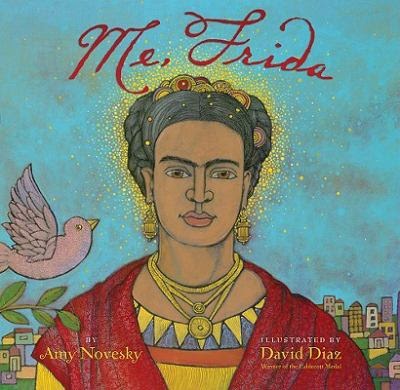
Evaluation: Diaz's illustrations and Novesky's prose complement each other perfectly in this gorgeous biography of Frida Kahlo. Even though the illustrations are reminiscent of Kahlo's works--the cover is particularly similar to many of Frida's self-portraits--Diaz utilizes his own style. Each page is completely washed in a variety of colors that drip and swirl artistically together as only watercolors can do. Diaz uses bright, deep jewel tones to celebrate Frida and her rich Mexican heritage. The colors range from deep blues and greens to vibrant oranges, violets and golds. He captures Frida's unique style of clothing and her iconic braids and each page is a new and fancifal scene in the life of these two famous artists. I especially loved the scene where Frida and Diego "fly" to San Francisco. The two are pictured flying through the air, holding hands with their eyes closed and heads raised to the wind as Frida clutches a suitcase in one hand. It opens the imagination and points out the humor and the nuances of the term, "fly". Above all, the book gives children a small taste of Kahlo's life and should encourage their interest in art history and instill a desire to learn more about this amazing woman.
Significance: Frida Kahlo is a celebrated artist and an important icon in art history. This biography introduces children to the wonder of Kahlo and teaches them that you can make your own dreams come true, even if there is someone in life who overshadows you.
Personal Choice: I used to teach a Humanities/English class and we were studying The House on Mango Street when I needed to find some artwork to complement the reading unit. I found the paintings of Frida Kahlo and Diego Rivera worked perfectly and since then they have always been artists of interest to me. I also began reading The Lacuna by Barbara Kingsolver in which the main character meets and works with both Frida and Diego and my interest was flamed even further.
Awards: Pura Belpre Illustrator Honor Book, 2011
by Amy Novesky
Illustrated by David Diaz
Abrahms, 2010. 32 pgs.
Reading Level: ages 4-8
Hardcover: $16.95
Annotation: Meet Frida Kahlo as she makes her home in San Francisco in this beautifully illustrated volume worthy of the artist herself.
Summary: Frida Kahlo was born in Mexico and married the famous Mexican artist, Diego Rivera. She was a painter in her own right, but not as famous as her husband. When Diego was asked to paint several murals for the city of San Franciso, Frida accompanied him on the journey to the United States. Diego and Frida toured the city together as Diego searched for inspiration for his murals. However, Frida did not enjoy her time in the foggy city at first and whenever the two went to parties, Frida stayed small and silent beside her giant, ebulliant husband. After awhile Frida went exploring on her own and began to see the beauties the city had to offer. She gained more confidence and one day she burst into song, regaling the crowd with traditional Mexican folksongs. After that she went home and began her famous wedding portrait of Diego and herself. This was the first painting in Frida's new style, which is intimate and folkloric than her previous works had been and it has become one of her most beloved works of art.
Evaluation: Diaz's illustrations and Novesky's prose complement each other perfectly in this gorgeous biography of Frida Kahlo. Even though the illustrations are reminiscent of Kahlo's works--the cover is particularly similar to many of Frida's self-portraits--Diaz utilizes his own style. Each page is completely washed in a variety of colors that drip and swirl artistically together as only watercolors can do. Diaz uses bright, deep jewel tones to celebrate Frida and her rich Mexican heritage. The colors range from deep blues and greens to vibrant oranges, violets and golds. He captures Frida's unique style of clothing and her iconic braids and each page is a new and fancifal scene in the life of these two famous artists. I especially loved the scene where Frida and Diego "fly" to San Francisco. The two are pictured flying through the air, holding hands with their eyes closed and heads raised to the wind as Frida clutches a suitcase in one hand. It opens the imagination and points out the humor and the nuances of the term, "fly". Above all, the book gives children a small taste of Kahlo's life and should encourage their interest in art history and instill a desire to learn more about this amazing woman.
Significance: Frida Kahlo is a celebrated artist and an important icon in art history. This biography introduces children to the wonder of Kahlo and teaches them that you can make your own dreams come true, even if there is someone in life who overshadows you.
Personal Choice: I used to teach a Humanities/English class and we were studying The House on Mango Street when I needed to find some artwork to complement the reading unit. I found the paintings of Frida Kahlo and Diego Rivera worked perfectly and since then they have always been artists of interest to me. I also began reading The Lacuna by Barbara Kingsolver in which the main character meets and works with both Frida and Diego and my interest was flamed even further.
Awards: Pura Belpre Illustrator Honor Book, 2011
Ling & Ting: Not Exactly the Same
by Grace Lin
Little, Brown & Company, 2010. 48 pgs.
Reading Level: ages 4-8
Hardcover: $14.99
Annotation: It's fun to be a twin, but just because you look alike, it doesn't mean you are exactly the same.
Summary: Ling & Ting are Chinese-American girls who happen to be twins; however, they are quick to assure us that they are not exactly the same even if they look very, very similar. In the first chapter the twins receive a haircut and Ling sits very still, but Ting sneezes as her hair is being cut which causes the barber to cut a large chunk from Ting's bang. Now the girls are easy to tell apart. Then Ling & Tings have several adventures involving magic tricks, making dumplings, eating with chopsticks and going to the library. It's fun to be a twin and the girls vow to stay together always, even when a king gets involved.
Evaluation: This chapter book is a nice addition to a young reader's collection. The pictures are bright and colorful and I especially loved the humorous beginning and ending pages. Ling & Ting are grabbing sodas and popcorn at the beginning and the caption reads "Shhh! It is starting! -- "Oh No! Are we late?". The last page shows the girls with their drinks as one says, "Was that the end?" and the other replies "No, this is!" as if the girls are telling us the story of their lives and wanting a front row seat of the action. The girls are really darling and have different personalities which the stories showcase, demonstrating that even when people look alike on the outside they can be different on the inside and still remain friends.
Significance: The book honors a multicultural heritage in that the twin protagonists are Chinese-American. There is a chapter featuring the children making chinese dumplings which introduces young readers to an important element of Chinese culture.
Personal Choice: What can I say, I've always had a fascination with twins that started with the Bobbsey Twins and always wished to have a set some day. Sadly, I'll have to be content with those found in books. :)
Awards: Theodor Geisel Honor Award, 2011
by Grace Lin
Little, Brown & Company, 2010. 48 pgs.
Reading Level: ages 4-8
Hardcover: $14.99
Annotation: It's fun to be a twin, but just because you look alike, it doesn't mean you are exactly the same.
Summary: Ling & Ting are Chinese-American girls who happen to be twins; however, they are quick to assure us that they are not exactly the same even if they look very, very similar. In the first chapter the twins receive a haircut and Ling sits very still, but Ting sneezes as her hair is being cut which causes the barber to cut a large chunk from Ting's bang. Now the girls are easy to tell apart. Then Ling & Tings have several adventures involving magic tricks, making dumplings, eating with chopsticks and going to the library. It's fun to be a twin and the girls vow to stay together always, even when a king gets involved.
Evaluation: This chapter book is a nice addition to a young reader's collection. The pictures are bright and colorful and I especially loved the humorous beginning and ending pages. Ling & Ting are grabbing sodas and popcorn at the beginning and the caption reads "Shhh! It is starting! -- "Oh No! Are we late?". The last page shows the girls with their drinks as one says, "Was that the end?" and the other replies "No, this is!" as if the girls are telling us the story of their lives and wanting a front row seat of the action. The girls are really darling and have different personalities which the stories showcase, demonstrating that even when people look alike on the outside they can be different on the inside and still remain friends.
Significance: The book honors a multicultural heritage in that the twin protagonists are Chinese-American. There is a chapter featuring the children making chinese dumplings which introduces young readers to an important element of Chinese culture.
Personal Choice: What can I say, I've always had a fascination with twins that started with the Bobbsey Twins and always wished to have a set some day. Sadly, I'll have to be content with those found in books. :)
Awards: Theodor Geisel Honor Award, 2011
Tuesday, March 22, 2011
26 Fairmount Avenue
26 Fairmount Avenue
written and illustrated by Tomie De Paola
G.P. Putnam's Sons, 1999. 57 pgs.
Reading Level: ages 9-12
Hardcover: $13.99
Annotation: Tomie can't wait for his new house on 26 Fairmount Avenue to be built, but will the big hurricane of '38 make his family's dreams disappear?
Summary: Tomie is 4 years old and his life is full of interesting adventures. It all begins with the big hurricane of 1938. Tomie and his family are living in an apartment and are hoping the big twister doesn't take their new house with it when it goes. Luckily, it's still standing and each chapter in the rest of the book details the interesting, funny adventures that little Tomie experiences as a boy. His mother takes him to see the first ever animated Walt Disney movie, Snow White and the Seven Dwarfs (at which he is disappointed that Walt hadn't read the book correctly). Tomie goes to kindergarten only to find out they don't teach you to read until first grade and thus immediately leaves in order to wait for next year. He visits with his Great-grandma nana (who is incidentally tied to a chair so she doesn't fall out) and they both happily consume chocolates only to find out later they just ate an entire package of laxatives. There are several other adventures, just as delightful as those, and it all ends with Tomie and his brother moving into their new home on 26 Fairmount Avenue.
Evaluation: In this splendid chapter book by De Paolo, the author creates a humorous and perfectly charming rendition of his own boyhood. He has wonderful stories to tell: the hurricane of 1938, watching the first Disney animation at the movies, his family's adventures building a new house and watching the year 1940 come in. It's gentle, engaging and a real treat that children today can exclaim over and make comparisons between their childhood and De Paolo's.
Significance: De Paolo grew up in a different era, but he takes some interesting experiences he had as a child and manages to make them appealing, verbally and visually, to children in the present day.
Personal Choice: I loved the idea of De Paolo naming the book after the house he lived in as a child. I think it's so much fun and so delightful when people name their houses (confession--my house is named Briar Rose Cottage).
Awards: Newbery Honor, 2000 / Wilder Winner, 2011
written and illustrated by Tomie De Paola
G.P. Putnam's Sons, 1999. 57 pgs.
Reading Level: ages 9-12
Hardcover: $13.99
Annotation: Tomie can't wait for his new house on 26 Fairmount Avenue to be built, but will the big hurricane of '38 make his family's dreams disappear?
Summary: Tomie is 4 years old and his life is full of interesting adventures. It all begins with the big hurricane of 1938. Tomie and his family are living in an apartment and are hoping the big twister doesn't take their new house with it when it goes. Luckily, it's still standing and each chapter in the rest of the book details the interesting, funny adventures that little Tomie experiences as a boy. His mother takes him to see the first ever animated Walt Disney movie, Snow White and the Seven Dwarfs (at which he is disappointed that Walt hadn't read the book correctly). Tomie goes to kindergarten only to find out they don't teach you to read until first grade and thus immediately leaves in order to wait for next year. He visits with his Great-grandma nana (who is incidentally tied to a chair so she doesn't fall out) and they both happily consume chocolates only to find out later they just ate an entire package of laxatives. There are several other adventures, just as delightful as those, and it all ends with Tomie and his brother moving into their new home on 26 Fairmount Avenue.
Evaluation: In this splendid chapter book by De Paolo, the author creates a humorous and perfectly charming rendition of his own boyhood. He has wonderful stories to tell: the hurricane of 1938, watching the first Disney animation at the movies, his family's adventures building a new house and watching the year 1940 come in. It's gentle, engaging and a real treat that children today can exclaim over and make comparisons between their childhood and De Paolo's.
Significance: De Paolo grew up in a different era, but he takes some interesting experiences he had as a child and manages to make them appealing, verbally and visually, to children in the present day.
Personal Choice: I loved the idea of De Paolo naming the book after the house he lived in as a child. I think it's so much fun and so delightful when people name their houses (confession--my house is named Briar Rose Cottage).
Awards: Newbery Honor, 2000 / Wilder Winner, 2011
Subscribe to:
Posts (Atom)