Strega Nona
written and illustrated by Tomie de Paola
Simon & Schuster, 1975. 32 pgs.
Reading Level: ages 4-8
Hardcover: $18.99
Annotation: When Big Anthony uses Strega Nona's magical pasta pot the whole town becomes endangered.
Summary: In the tiny Italian village of Calabria, Strega Nona (Grandma Witch) performed all sorts of magical potions for the villagers, but Strega Nona was getting old in need of someone to help her with her house and garden. Big Anthony applied for the job and did fine work, but Strega Nona warned him never to touch her big pot. One day Big Anthony spied Strega Nona making pasta in her pot from the window. Strega Nona sang a song and the pot began making pasta all be itself, then she sang another song and the pot stopped, providing just enough past for Strega Nona. It was magic! Big Anthony was delighted. One day Strega Nona had to travel to a neighboring village and as she departed, she warned Big Anthony not to touch her big pot. But Big Anthony did not obey and as soon as she left he sang the song and sure enough, the pasta started growing like magic. When he had enough, he sang the song to make the pot stop cooking, but he had not seen Strega Nona blow three kisses that day he spied on her through the window. The pasta kept growing, and growing and growing and growing until the entire village was overrun with the thick strands of pasta. Horrified, Big Anthony kept singing the song to make the pasta pot stop, but to his frustration it would not work without the three kisses he had never seen Strega Nona deliver. As the village was about to be destroyed, Strega Nona appeared and realized what Big Anthony had done. She immediately sang the magic song, blew three kisses and the village was saved. But, Big Anthony got in very big trouble and Strega Nona made sure his punishment fit the crime.
Evaluation: De Paolo does a fantastic job turning this Italian folktale into a charming story that readers in the present day continue to enjoy. His illustration style relies heavily on folkart and thus the tale and the illustrations complement each other perfectly. The images are subdued, a bit simple, but so engaging. I love how the strands of pasta curve and wind thickly around the villagers homes and belongings. De Paolo is spare in the illustration details, but if you look closely, the expression on Strega Nona's face as she returns to her village overrun with pasta is priceless. As one reader relay's, "it is a fun blend of magic, fantasy and adolescent mischief". I have to agree. This title is a classic tale, ever popular and undenyingly relevant, despite it's having been published in the 70's. With a strong moral and excellent drawings, this title should remain a hit for years to come.
Significance: Big Anthony learns there is often a very good reason you are told not to do something and when he chooses to defy the rules he is forced to pay a high price for his disobedience.
Personal Choice: I learned this was one of de Paolo's most beloved books when I was reading about the Wilder award and I had to see what all the fuss was about. I found out it was published the year I was born! Shhh, don't tell--now it has a very special place in my heart.
Awards: Wilder Winner, 2011 / Caldecott Honor Award, 1976 / ALA Notable Children's Book / Kirkus Choice / Horn Book Honor List / Nakamori Prize / Brooklyn Museum & Public Library Art Books for Children Citation (N.Y.)
Always read something that will make you look good if you die in the middle of it. ~P.J. O'Rourke
Showing posts with label Wilder Award. Show all posts
Monday, March 28, 2011
Tuesday, March 22, 2011
26 Fairmount Avenue
26 Fairmount Avenue
written and illustrated by Tomie De Paola
G.P. Putnam's Sons, 1999. 57 pgs.
Reading Level: ages 9-12
Hardcover: $13.99
Annotation: Tomie can't wait for his new house on 26 Fairmount Avenue to be built, but will the big hurricane of '38 make his family's dreams disappear?
Summary: Tomie is 4 years old and his life is full of interesting adventures. It all begins with the big hurricane of 1938. Tomie and his family are living in an apartment and are hoping the big twister doesn't take their new house with it when it goes. Luckily, it's still standing and each chapter in the rest of the book details the interesting, funny adventures that little Tomie experiences as a boy. His mother takes him to see the first ever animated Walt Disney movie, Snow White and the Seven Dwarfs (at which he is disappointed that Walt hadn't read the book correctly). Tomie goes to kindergarten only to find out they don't teach you to read until first grade and thus immediately leaves in order to wait for next year. He visits with his Great-grandma nana (who is incidentally tied to a chair so she doesn't fall out) and they both happily consume chocolates only to find out later they just ate an entire package of laxatives. There are several other adventures, just as delightful as those, and it all ends with Tomie and his brother moving into their new home on 26 Fairmount Avenue.
Evaluation: In this splendid chapter book by De Paolo, the author creates a humorous and perfectly charming rendition of his own boyhood. He has wonderful stories to tell: the hurricane of 1938, watching the first Disney animation at the movies, his family's adventures building a new house and watching the year 1940 come in. It's gentle, engaging and a real treat that children today can exclaim over and make comparisons between their childhood and De Paolo's.
Significance: De Paolo grew up in a different era, but he takes some interesting experiences he had as a child and manages to make them appealing, verbally and visually, to children in the present day.
Personal Choice: I loved the idea of De Paolo naming the book after the house he lived in as a child. I think it's so much fun and so delightful when people name their houses (confession--my house is named Briar Rose Cottage).
Awards: Newbery Honor, 2000 / Wilder Winner, 2011
written and illustrated by Tomie De Paola
G.P. Putnam's Sons, 1999. 57 pgs.
Reading Level: ages 9-12
Hardcover: $13.99
Annotation: Tomie can't wait for his new house on 26 Fairmount Avenue to be built, but will the big hurricane of '38 make his family's dreams disappear?
Summary: Tomie is 4 years old and his life is full of interesting adventures. It all begins with the big hurricane of 1938. Tomie and his family are living in an apartment and are hoping the big twister doesn't take their new house with it when it goes. Luckily, it's still standing and each chapter in the rest of the book details the interesting, funny adventures that little Tomie experiences as a boy. His mother takes him to see the first ever animated Walt Disney movie, Snow White and the Seven Dwarfs (at which he is disappointed that Walt hadn't read the book correctly). Tomie goes to kindergarten only to find out they don't teach you to read until first grade and thus immediately leaves in order to wait for next year. He visits with his Great-grandma nana (who is incidentally tied to a chair so she doesn't fall out) and they both happily consume chocolates only to find out later they just ate an entire package of laxatives. There are several other adventures, just as delightful as those, and it all ends with Tomie and his brother moving into their new home on 26 Fairmount Avenue.
Evaluation: In this splendid chapter book by De Paolo, the author creates a humorous and perfectly charming rendition of his own boyhood. He has wonderful stories to tell: the hurricane of 1938, watching the first Disney animation at the movies, his family's adventures building a new house and watching the year 1940 come in. It's gentle, engaging and a real treat that children today can exclaim over and make comparisons between their childhood and De Paolo's.
Significance: De Paolo grew up in a different era, but he takes some interesting experiences he had as a child and manages to make them appealing, verbally and visually, to children in the present day.
Personal Choice: I loved the idea of De Paolo naming the book after the house he lived in as a child. I think it's so much fun and so delightful when people name their houses (confession--my house is named Briar Rose Cottage).
Awards: Newbery Honor, 2000 / Wilder Winner, 2011
Friday, February 25, 2011
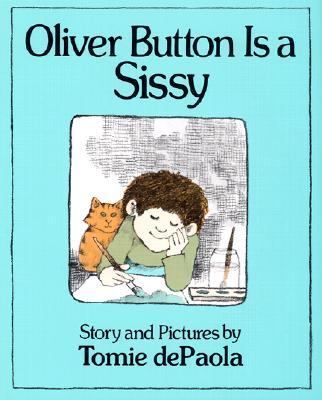
Oliver Button is a Sissy
written and illustrated by Tomie dePaolo
Harcourt Childrens Books, 1979. 48 pgs.
Reading Level: ages 4-8
Hardcover: $15.99
Annotation: Oliver Button doesn't like to play football with the other boys, he likes to dance.
Summary: Oliver Button doesn't like to do the things that boys do. He doesn't \
like sports because he is not very good at them. Instead, he loves to read and draw, play with dolls and jump rope in the woods. Oliver Button loves to dress up and pretend he is a movie star and he especially loves to dance. So his mother enrolls him for Ms. Leah's dance class and buys him some shiny new tap shoes. All the boys at school make fun of him and call him a sissy, even his father. But Oliver Button doesn't let that bother him and practices and practices anyway. One day at the local talent show he demonstrates what an amazing dancer he really is. Even though he doesn't win, his father finally tells him he is "great" and the next day at school, instead of being a sissy, he is a star.
Evaluation: Oliver Button is an endearing little boy and the dePaolo's use of both his first and last name is even more charming. But is the illustrations which make Oliver come to life. The tale follows the life of Oliver as he particpates in the things he loves, instead of following what society prescribes. Oliver Button tells an important truth and does so in a manner that children can both understand and learn from, while enjoying the fun and playful nature of dePaolo's artwork. As the School Library Journal says, “There is a good balance between the simple text . . . and the expressive pictures . . . an attractive little book.” Like, Oliver, dePaolo also loved to draw more than play sports and look where that landed him, with numerous awards and this year's Wilder winner.
Significance: It's not easy being different, but this book helps children realize it is okay for boys to like hobbies that have been traditionally assigned to the female gender. Even when everyone is telling you to do one thing, if you follow your heart, it will be okay in the end.
Personal Choice: Admittedly, the title of this book immediately captured by attention and I had to find out just what Oliver Button was up to.
Awards: Laura Ingalls Wilder Winner, 2011 / IRA-CBC Children's Choice
written and illustrated by Tomie dePaolo
Harcourt Childrens Books, 1979. 48 pgs.
Reading Level: ages 4-8
Hardcover: $15.99
Annotation: Oliver Button doesn't like to play football with the other boys, he likes to dance.
Summary: Oliver Button doesn't like to do the things that boys do. He doesn't \
like sports because he is not very good at them. Instead, he loves to read and draw, play with dolls and jump rope in the woods. Oliver Button loves to dress up and pretend he is a movie star and he especially loves to dance. So his mother enrolls him for Ms. Leah's dance class and buys him some shiny new tap shoes. All the boys at school make fun of him and call him a sissy, even his father. But Oliver Button doesn't let that bother him and practices and practices anyway. One day at the local talent show he demonstrates what an amazing dancer he really is. Even though he doesn't win, his father finally tells him he is "great" and the next day at school, instead of being a sissy, he is a star.
Evaluation: Oliver Button is an endearing little boy and the dePaolo's use of both his first and last name is even more charming. But is the illustrations which make Oliver come to life. The tale follows the life of Oliver as he particpates in the things he loves, instead of following what society prescribes. Oliver Button tells an important truth and does so in a manner that children can both understand and learn from, while enjoying the fun and playful nature of dePaolo's artwork. As the School Library Journal says, “There is a good balance between the simple text . . . and the expressive pictures . . . an attractive little book.” Like, Oliver, dePaolo also loved to draw more than play sports and look where that landed him, with numerous awards and this year's Wilder winner.
Significance: It's not easy being different, but this book helps children realize it is okay for boys to like hobbies that have been traditionally assigned to the female gender. Even when everyone is telling you to do one thing, if you follow your heart, it will be okay in the end.
Personal Choice: Admittedly, the title of this book immediately captured by attention and I had to find out just what Oliver Button was up to.
Awards: Laura Ingalls Wilder Winner, 2011 / IRA-CBC Children's Choice
Subscribe to:
Posts (Atom)