Showing posts with label Picture Books. Show all posts

Monday, March 28, 2011

Flotsam

Flotsam
illustrated by David Wiesner
Clarion, 2006. 40 pgs.
Reading Level: ages 4-8
Hardcover: $17.00

Annotation: When a camera washes up on the beach, the mysteries of the ocean are revealed in a most surprising way.

Summary: At the beach, a young boy is examining the bugs, crabs and other sand creatures when a huge wave deposits an old camera on the shore. The yellow-haired boy tries to find the owner to this mysterious underwater camera, but to no avail and so he takes the film to be developed. When the pictures are finally ready he discovers a world he never knew existed. The photos reveal all the magic that happens underneath the ocean's surface. He sees pictures of mechanical fish, octupuses sitting in living rooms reading books, turtles with whole towns made of shells on their backs and even little green men riding fish and meeting seahorses. But then he makes the most amazing discovery of all. He finds a picture of an Asian girl holding a picture of another boy, holding a picture of a girl who is holding the picture of yet another child! As he uses his magnifying glass he discovers the pictures date back far back in the past. Children from all over the world have been using this camera to take pictures of themselves and then sending the camera back to the sea for another child to uncover and discover the wonders of the ocean. The yellow-haired boy holds up the picture of the girl, snaps a picture of himself and then throws the camera back into the ocean, where it is found by a stingray and carried by seahorses to be discovered by another lucky child in the future.

Evaluation: Told strictly through illustration, Flotsam takes the reader on a magical journey through the wonders and mysteries of oceanlife. Weisner's imagination is deliciously fantastical as he creates a world where merpeople have fish named Spot (due to their spots of course) and ride on stingrays through the lampost lit jungle of the ocean floor. There is a combination of the real and the imaginary that delights the senses and turns the sometimes scary ocean into a place of thrilling discovery. The story is ever so clever and the images are bright and playful. The illustrations mirror the book's theme, being set in black-rimmed squares and rectangles, just like a photograph. Weisner's mode of storytelling, wherein children discover the camera and photograph themselves holding photos of other children, is ingenious and the book is simply irresistable.  I am in complete and utter love with this book and proclaim it absolutely and undeniably worthy of being a Caldecott winner. Weisner is no newcomer to the Caldecott and he has several winners and honors to his name and his books have been translated in over a dozen languages. However, he excels in wordless storytelling, where translation is unnecessary and Flotsam is a book that any child, anywhere can appreciate.

Significance: This title introduces readers to the mystery and magic of what lies beneath the ocean's waves. The ocean can be a scary place when you're unable to see what's happening, but Weisner offers an explanation of underwater life that wipes away the fear and creates a safe, playful interpretation instead. Whether it's absolutely true or not is just part of what makes the ocean so fascinating. With a little imagination, anything can be true.

Personal Choice: I was utterly enchanted by the deep red background cover, schools of tiny fish swimming by and the ever so mysterious porthole eye right in the center. As always, you shouldn't judge a book by its cover, but if it's a picture book, than you have to, right?

Awards: Caldecott Award Winner, 2007 / ABA - Book Sense Book of the Year: Illustration Honor, 2007

Strega Nona

Strega Nona
written and illustrated by Tomie de Paola
Simon & Schuster, 1975. 32 pgs.
Reading Level: ages 4-8
Hardcover: $18.99

Annotation: When Big Anthony uses Strega Nona's magical pasta pot the whole town becomes endangered.

Summary: In the tiny Italian village of Calabria, Strega Nona (Grandma Witch) performed all sorts of magical potions for the villagers, but Strega Nona was getting old in need of someone to help her with her house and garden. Big Anthony applied for the job and did fine work, but Strega Nona warned him never to touch her big pot. One day Big Anthony spied Strega Nona making pasta in her pot from the window. Strega Nona sang a song and the pot began making pasta all be itself, then she sang another song and the pot stopped, providing just enough past for Strega Nona. It was magic! Big Anthony was delighted. One day Strega Nona had to travel to a neighboring village and as she departed, she warned Big Anthony not to touch her big pot. But Big Anthony did not obey and as soon as she left he sang the song and sure enough, the pasta started growing like magic. When he had enough, he sang the song to make the pot stop cooking, but he had not seen Strega Nona blow three kisses that day he spied on her through the window. The pasta kept growing, and growing and growing and growing until the entire village was overrun with the thick strands of pasta. Horrified, Big Anthony kept singing the song to make the pasta pot stop, but to his frustration it would not work without the three kisses he had never seen Strega Nona deliver. As the village was about to be destroyed, Strega Nona appeared and realized what Big Anthony had done. She immediately sang the magic song, blew three kisses and the village was saved. But, Big Anthony got in very big trouble and Strega Nona made sure his punishment fit the crime.

Evaluation: De Paolo does a fantastic job turning this Italian folktale into a charming story that readers in the present day continue to enjoy. His illustration style relies heavily on folkart and thus the tale and the illustrations complement each other perfectly. The images are subdued, a bit simple, but so engaging. I love how the strands of pasta curve and wind thickly around the villagers homes and belongings. De Paolo is spare in the illustration details, but if you look closely, the expression on Strega Nona's face as she returns to her village overrun with pasta is priceless.  As one reader relay's, "it is a fun blend of magic, fantasy and adolescent mischief". I have to agree. This title is a classic tale, ever popular and undenyingly relevant, despite it's having been published in the 70's. With a strong moral and excellent drawings, this title should remain a hit for years to come.

Significance: Big Anthony learns there is often a very good reason you are told not to do something and when he chooses to defy the rules he is forced to pay a high price for his disobedience.

Personal Choice: I learned this was one of de Paolo's most beloved books when I was reading about the Wilder award and I had to see what all the fuss was about. I found out it was published the year I was born! Shhh, don't tell--now it has a very special place in my heart.

Awards: Wilder Winner, 2011 / Caldecott Honor Award, 1976 / ALA Notable Children's Book / Kirkus Choice / Horn Book Honor List / Nakamori Prize / Brooklyn Museum & Public Library Art Books for Children Citation (N.Y.)

Friday, March 25, 2011

What Can You Do with a Rebozo?

What Can You Do with a Rebozo?
by Carmen Tafolla
Illustrated by Amy Cordova
Tricycle Press, 2008. 32 pgs
Reading Level: ages 4-8
Hardcover: $14.95

Annotation: With a little creativity, a Rebozo can be used in so many different ways.

Summary: In Mexico, a Rebozo is used for so many different things. Traditionally it is used as a shawl for Mama, but it can also be wrapped around her body and used as a cradle for baby. A Rebozo can be used as a cave for brother during hide-and-seek or looped through a braid to make sister's hair prettier. Grandma uses her Rebozo to keep her warm during the Winter or it can be used to wipe up spills in the kitchen. With a little imagination it is used as a secret tunnel or a sash for pirates, a flying cape, or a long red slide. But the little girl loves to use it when she dances to her favorite song, "La Bamba". At evening time, when she is tired Mama  uses it to cover her as she tucks her in at night.

Evaluation: Tafollo and Cordova have created a magical picture book highlighting the creative uses one family finds for a Rebozo. The illustrations are reminiscent of Mexico with their vibrant, hot colors and you'll wish you could step into the pages and dance with the little girl or play hide-and-seek with her brother. And above all, you'll want to go out and find your very own Rebozo to experiment with.

Significance: A Rebozo is a foreign term for many of America's children and the book celebrates a small but significant part of Mexican culture. The title is a wonderful introduction for young readers who do not know what a Rebozo is, as well as being a fun adventure for children who do. The title celebrates Mexico's increasing influence on American culture and is a testiment to the beauty of the imagination.

Personal Choice: I absolutely loved Tafolla's What can you do with a Paleta? and when I found out she had another book with a similar theme (and one which had won a Pura Belpre) I was excited to experience more of her imaginative world.

Awards: Pura Belpre Illustration Honor, 2009

Wednesday, March 23, 2011

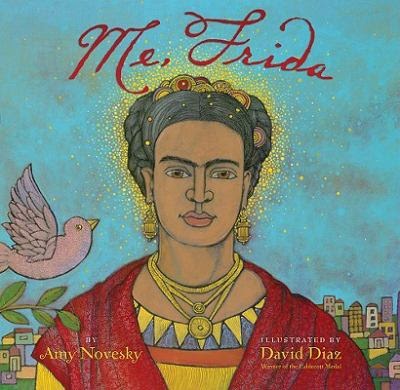
Me, Frida

Me, Frida
by Amy Novesky
Illustrated by David Diaz
Abrahms, 2010. 32 pgs.
Reading Level: ages 4-8
Hardcover: $16.95

Annotation: Meet Frida Kahlo as she makes her home in San Francisco in this beautifully illustrated volume worthy of the artist herself.

Summary: Frida Kahlo was born in Mexico and married the famous Mexican artist, Diego Rivera. She was a painter in her own right, but not as famous as her husband. When Diego was asked to paint several murals for the city of San Franciso, Frida accompanied him on the journey to the United States. Diego and Frida toured the city together as Diego searched for inspiration for his murals. However, Frida did not enjoy her time in the foggy city at first and whenever the two went to parties, Frida stayed small and silent beside her giant, ebulliant husband. After awhile Frida went exploring on her own and began to see the beauties the city had to offer. She gained more confidence and one day she burst into song, regaling the crowd with traditional Mexican folksongs. After that she went home and began her famous wedding portrait of Diego and herself. This was the first painting in Frida's new style, which is intimate and folkloric than her previous works had been and it has become one of her most beloved works of art.

Evaluation: Diaz's illustrations and Novesky's prose complement each other perfectly in this gorgeous biography of Frida Kahlo. Even though the illustrations are reminiscent of Kahlo's works--the cover is particularly similar to many of Frida's self-portraits--Diaz utilizes his own style. Each page is completely washed in a variety of colors that drip and swirl artistically together as only watercolors can do.  Diaz uses bright, deep jewel tones to celebrate Frida and her rich Mexican heritage. The colors range from deep blues and greens to vibrant oranges, violets and golds. He captures Frida's unique style of clothing and her iconic braids and each page is a new and fancifal scene in the life of these two famous artists. I especially loved the scene where Frida and Diego "fly" to San Francisco. The two are pictured flying through the air, holding hands with their eyes closed and heads raised to the wind as Frida clutches a suitcase in one hand. It opens the imagination and points out the humor and the nuances of the term, "fly". Above all, the book gives children a small taste of Kahlo's life and should encourage their interest in art history and instill a desire to learn more about this amazing woman.

Significance: Frida Kahlo is a celebrated artist and an important icon in art history. This biography introduces children to the wonder of Kahlo and teaches them that you can make your own dreams come true, even if there is someone in life who overshadows you.

Personal Choice: I used to teach a Humanities/English class and we were studying The House on Mango Street when I needed to find some artwork to complement the reading unit. I found the paintings of Frida Kahlo and Diego Rivera worked perfectly and since then they have always been artists of interest to me. I also began reading The Lacuna by Barbara Kingsolver in which the main character meets and works with both Frida and Diego and my interest was flamed even further.

Awards: Pura Belpre Illustrator Honor Book, 2011

Wednesday, March 16, 2011

Big Red Lollipop

Big Red Lollipop
by Rukhasana Khan
Illustrated by Sophie Blackall
Viking, 2010. 40 pgs.
Reading Levl: ages 4-9
Hardcover: $16.99

Annotation: When Rubina is invited to a birthday party, will she be forced her to take her little sister?

Summary: When Rubina is invited to her very first birthday party, (Ami is puzzled as to why they would celebrate the day of your birth) her little sister, Sani, begs to go. Ami tells Rubina that if she wants to go she must take Sani, but Rubina knows no one else will have their little sister there. But, she reluctantly drags her along and sure enough, everyone thinks she is weird. The girls play games and eat birthday cake and are given a big bag full of goodies at the end of the party, complete with a large, delectable red lollipop. Sani gobbles hers up, but Rubina wants to save hers. However, the next morning she awakes to find Sani has eaten most of her red lollipop as well! Life is so unfair and Rubina is very angry. But Ami scolds her and tells her she must share. Later on though, Sani receives an inviation to a birthday party and the girls' little sister Maryam begs to go, creating the same dilemma all over again. Ami says both Rubina and Maryam must acompany Sani to the party, just to be fair. Luckily, Rubina is mature enough to realize this will be tragic for Sani and so she convinces Ami that Sani must go alone as the culture dictates. After the party Sani brings home a big green lollipop and gives it to Rubina as a peace offering and the girls are friends again.

Evaluation: The storyline is wonderful and discusses the hardships, as well as the joys, that having a sister brings. It is especially interesting as the family is Arab-American, with the mother garbed in a hajib and Middle-eastern dress while the girls wear American clothing. There is a bit of culture misunderstanding when the mother decides all the girls must go to a party if one of them is invited. It demonstrates the solidarity of Middle-eastern family life and offers a rare glimpse into what must be commonplace for the author and unusual for an American audience. The illustrations are irresistible, and the cover art is especially eye-catching with its bright primary colors and the red lollipop that covers Rubina's eye is artfully placed. I loved inner cover at the beginning and end of the book with their multi-size circles of all different patterns and colors: poka-dots, stripes, checks and spirals. The colors are bright and fun and Ami's saris are so alluring with their fancy patterns and exotic design. The story and the illustrations work together beautifully to create a well-awarded picture book that's sure to be a winner, now and in the future.

Significance: The story's protagonist is an Arab-American which makes the book a welcome addition to a world that is currently in the midst of turbulent political and emotional battles. The story serves to humanize a people and culture that is often misunderstood and demonized. It's an important work and perhaps our mutual culture's children will learn to understand and accept one another, even when the adults can do nothing but fight.

Personal Choice: Let's be honest, I have a sugar addiction and if it's a book about candy, I'm there.

Awards: Charlotte Zolotow Award Winner, 2011 / Children's Notables, 2011 / Golden Kite Award Winner for Picture Book Text, 2011

Kitten's First Full Moon

Kitten's First Full Moon
written and illustrated by Kenvin Henkes
Greenwillow Books, 2005. 40 pgs.
Reading Level: Baby - Preschool
Hardcover: $17.99

Annotation: Kitten desperately tries to reach the bowl of milk she sees in the sky, not realizing that she's chasing after the moon.

Summary: When Kitten spies the full moon in the sky she immediately thinks it must be a bowl of milk and so she tries to lick it, capturing a bug instead. And thus begins a rollicking adventure that takes her across fields and fences and even near a pond where the moon is reflected in the water, causing kitten to see another giant bowl of milk that she is again unable to sip. Finally she returns back home, hungry, tired and wet only to find an actual bowl of milk has been placed outside for her to drink.

Evaluation: The illustrations are all in black and white and the story is really darling. However, I must admit that I was a bit shocked to see that Henkes actually won the Caldecott for the illustrations. They don't communicate anything special and the only one that actually appeals to me is the cover illustration. I'd really like to have been on the Caldecott committee that year in order to hear the committee deliberations and to see what other options they had to work with. Final note, it's okay, but not stupendous and I'm still shaking my head over this award winner.

Significance: For the most part, children are fascinated with animals, especially baby ones and this story places a treasured creature at the heart of the plot. We also see kitten learning a lesson that everything is not always what it seems to be and that is something we all must learn sooner or later.

Personal Choice: I wanted to read this book because a friend and artist neighbor of mine is working with Kevin Henkes on a project and I thought it would be interesting to learn more about his style.

Awards: Caldecott Winnter, 2005 / ABA - Book Sense Book of the Year: Illustration Honor, 2005

Tuesday, March 15, 2011

April and Esme: Tooth Fairies

April and Esme: Tooth Fairies
by Bob Graham
Candlewick Press, 2010. 36 pgs.
Reading Level: ages 3-8 pgs
Hardcover: $16.99

Annotation: April and Esme are tooth fairies who desperately want to convince their parents they are old enough to collect their very first tooth.

Summary: April gets a call on her cell phone from Daniel Dangerfield's grandmother saying a tooth needs collecting. They fly home to convince their parents they are old enough, at 6 and 7, to collect their very first tooth. Mom and Dad are reluctant, but finally give permission if the fairies are very careful, especially of the new highway. As the fairies spy Daniel's house they scoot under his doorway and follow the trail of toys up to Daniel's bedroom. Uh-oh! Daniel wakes up, but the fairies carefully close his eyelids and whisper in his ear that they are spirits of the air and he has only dreamed them. They exchange the coin for his tooth and fly successfully home, welcomed by mom and dad with lots of hugs and wing crackles. They've passed their first tooth test and are ready for a good day's sleep.

Evaluation: I can't say enough about Graham's utterly charming tooth fairy tale. The mixture of technology and magic is simply delightful as April, a 7-year-old tooth fairy, receives tooth communication orders via cell phone. It's a combination of old and new world magic. The images are nice and whimsical with details that simply charm your socks off. At one point the girls' mother is getting ready and turns her blowdryer up so April can float on the cloud of air it produces. And the toilet has a picture of a chicken on it! I was enchanted by the teapot the girls' mother uses for a bath and the tiny little sink is a beautiful golden thimble. And the humor can be appreciated by adult and child alike; Daniel's tooth has been placed in a cup of water and as the girls leave they go and visit his grandmother, who has her false teeth placed in a cup besisde her bed as well. April reminds Esme that they don't take those kind of teeth, though. Ta-da! And the tiny touches Graham adds to his images add lots of interesting character details, such as Esme's glasses and their dad's hippy-esque ponytail, two things you wouldn't normally expect of fairy creatures. And these fairies hang their collected teeth from the rafters of their tiny little stump home (established in 1691). In essence, it's charming, fanciful and a perfect explanation of just how tooth fairies really work in this day and age.

Significance: Losing your teeth and setting them out for the tooth fairy to collect is a right of passage for all young ones and this story addresses a common occurrence that everyone can relate to.

Personal Choice: I remember when I first learned the truth about the tooth fairy and I wanted to see Graham's interpretation of the "truth". Plus the cover art was so enchanting!

Awards: Charlotee Zolotow Honor, 2011 / Children's Notables, 2011

Thank You Bear

Thank You Bear
written and illustrated by Greg Foley
Viking, 2007. 32 pgs
Reading Level: ages 3-7
Hardcover: $15.99

Annotation: Bear finds it difficult to convince his friends he has found the perfect box.

Summary: One morning Bear finds the perfect box. In his excitement, he wants to share this treasure with all of his friends, including: Monkey, Owl, Fox, Elephant and Bunny. No one seems to appreciate his find as much as Bear does though, and he begins to wonder whether or not his box is really so great after all. However, Mouse comes along and is just as entranced with the perfect little box as Bear was and he feels buoyed up again by her admiration and approval as she curls up inside and pronounces it "the greatest thing ever".
Evaluation: The book is very simply laid out. The words are large and bold and the images are sparing. Every other page is washed with a block of color, on which the words are overlayed and the opposing page presents the image of Bear with his box the animal of the moment. I loved the book's message, but wasn't as impressed with the artwork. However, perhaps the simplicity works for a young child and message's innate truth deserves to be told.
Significance: We are all surrounded by those who would rain negativity on our choices or our very person. That is why having a friend appreciate us and our work is such a treasure. Bear is lucky to have found such a friend in Mouse. Would that we all have someone to get as excited with us over our finds as Mouse does.

Personal Choice: I wanted to read this book because who didn't love their stuffed bear growing up?

Awards: Charlotte Zolotow Award Winner, 2008

Friday, March 4, 2011

Ballet for Martha: Making Appalachian Spring

Ballet for Martha: Making Appalachian Spring
by Jan Greenberg and Sandra Jordan
Illustrated by Brian Floca
Flashpoint, 2010. 48 pgs
Reading Level: ages 9-12
Hardcover: $17.99

Annotation: Learn about the inspiration behind Martha Graham's most famous ballet in this beautifully illustrated work of poetic luminance.

Summary:  For more than 60 years, audiences have delighted in Martha Graham's famous ballet, Appalachian Spring. Ballet for Martha tells the story of it's creation and the collaboration that took place between three amazing artists: the famous musician Aaron Copland, Martha herself and the artist, Isamu Noguchi. This informative children's book traces the history of a new kind of ballet, where the "legend of American living" was to be danced out on stage, celebrating Springtime and the marriage of a young pioneer couple. Copeland's famous musical score lent the ballet inspiration and his penned notation at the top of the music "Ballet for Martha" lent the book it's name. Each stage of the ballet's creation is documented, from the costume choices and stage design to the reception the ballet received on opening night in 1944.

Evaluaton: Brian Floca's lustrous watercolors perfectly complement the stunning and poetic cant of this fascinating history of Martha Graham's Appalachian Spring. The title is a welcome addition to history in general and the arts specifically, finishing with wonderful biographies of all three collaborative artists: Martha Graham, Aaron Copland, and Isamu Noguchi. It is an outstanding work of nonfiction and much deserves the Siebert Honor.

Significance: Appalachian Spring enjoys a loving and prominent place in the history of modern ballet and Copeland won the Pultizer Prize with this famous musical score. This book is a beautifully rendered history of a significant event in the history of the arts and deserves a prominent place in any library.

Personal Choice: Having a background in ballet and modern dance I was anxious to read more about Martha Graham and learn about her famous Appalachian Spring. I love Aaron Copeland's music and was thrilled to learn more about his use of "Tis a Gift to be Simple..." in the ballet score.

Awards: Robert F. Siebert Informational Book Honor, 2011

Friday, February 25, 2011

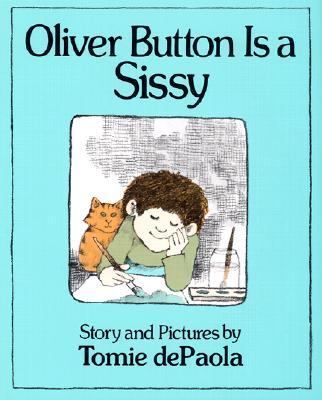
Oliver Button is a Sissy

Oliver Button is a Sissy
written and illustrated by Tomie dePaolo
Harcourt Childrens Books, 1979. 48 pgs.
Reading Level: ages 4-8
Hardcover: $15.99

Annotation: Oliver Button doesn't like to play football with the other boys, he likes to dance.

Summary: Oliver Button doesn't like to do the things that boys do. He doesn't \
like sports because he is not very good at them. Instead, he loves to read and draw, play with dolls and jump rope in the woods. Oliver Button loves to dress up and pretend he is a movie star and he especially loves to dance. So his mother enrolls him for Ms. Leah's dance class and buys him some shiny new tap shoes. All the boys at school make fun of him and call him a sissy, even his father. But Oliver Button doesn't let that bother him and practices and practices anyway. One day at the local talent show he demonstrates what an amazing dancer he really is. Even though he doesn't win, his father finally tells him he is "great" and the next day at school, instead of being a sissy, he is a star.

Evaluation: Oliver Button is an endearing little boy and the dePaolo's use of both his first and last name is even more charming. But is the illustrations which make Oliver come to life. The tale follows the life of Oliver as he particpates in the things he loves, instead of following what society prescribes. Oliver Button tells an important truth and does so in a manner that children can both understand and learn from, while enjoying the fun and playful nature of dePaolo's artwork.  As the School Library Journal says,  “There is a good balance between the simple text . . . and the expressive pictures . . . an attractive little book.”  Like, Oliver, dePaolo also loved to draw more than play sports and look where that landed him, with numerous awards and this year's Wilder winner.

Significance: It's not easy being different, but this book helps children realize it is okay for boys to like hobbies that have been traditionally assigned to the female gender. Even when everyone is telling you to do one thing, if you follow your heart, it will be okay in the end.

Personal Choice: Admittedly, the title of this book immediately captured by attention and I had to find out just what Oliver Button was up to.

Awards: Laura Ingalls Wilder Winner, 2011 / IRA-CBC Children's Choice

Tuesday, February 22, 2011

What Can You Do With a Paleta?

What Can You Do With a Paleta? / Que Puedas Hacer Con Una Paleta?
by Carmen Tafolla
Illustrated by Magaly Morales
Tricycle Press, 2009. 32 pgs.
Reading Level: ages 3-8
Hardcover: $14.99

Annotation: When the warmth of summertime shines down, just what can you do with a paleta?

Summary: In a Mexican barrio a little girl shares all the ways she can make magic with a paleta. This charming tale explores the many uses little ones can find for a traditional Mexican popsicle treat. From painting your tongue different colors to scare your little brother to drawing colorful, sugary masterpieces on the sidewalk, a paleta is a wonderful pleasure.

Evaluation: With gorgeous, brightly colored illustrations, Morales shares the warmth of Mexico and coolness of a summertime treat. She effectively captures the essence of youth and the vibrancy of her work makes you thirst for your own paleta. With a lovely, poetic prose Tafolla recounts the joys of her own little village (barrio) and the marraige between text and image is a seemless masterpiece.

Significance: The work highlights a large sub-culture within the United States that is growing at tremendous rates. This is a dual language book, with each page written in  both  English and Spanish. It's a perfect introduction to either a Spanish-speaking or English-speaking child who wants to learn the other language and is a delightful work in both languages.

Personal Choice: I wanted to read this book because I'm trying to learn Spanish and I couldn't wait to find out just what a paleta was!

Awards: Charlotte Zolotow Award Winner, 2010

Dave the Potter: Artist, Poet, Slave

Dave the Potter: Artist, Poet, Slave
by Lavan Carrick Hill
Illustrated by Bryan Collier
Little, Brown & Company, 2010. 48 pgs
Reading Level: ages 4-8
Hardcover: $16.99

Annotation: Even though he was a slave, Dave the Potter made beautiful pots inscribed with his own special poetry.

Summary: Dave the Potter was an extraordinary slave artist living in South Carolina in the 1800's. This exquisite picture book tells the story of his art, how he took earth and clay, combined them with water and then threw pots large enough to hold more than 20 gallons. Afterwhich, he inscribed them with his short, fascinating haiku-like snatches of poetry. Sometimes he only signed his name but other times he wrote lines such as "I wonder where is all my relation friendhsip to all-and, every nation". At the end of the story proper, the full story of Dave and the making of the tale add a more definitive look into the life of the artist and complement the book's main body.

Evaluation: The book is a must read for anyone interested in the history of African American art. The illustrations are subdued, using darker, muted colors for the most part and exhibiting a layered effect that is visually interesting as well as gorgeously rendered. Dave's face and his hands are life catching glimpses into this man's soul and I loved the fold out pages that let you see the steps a potter follows when creating a pot. It's an important work in that it documents a unique man in history and his extraordinary talent and the illustrations are a triumphant celebration of Dave's life.

Significance: Slaves were normally forced to remain unskilled and illiterate, the fact that Dave was both shows special privilege and  remarkable talent.

Personal Choice: I have a degree in art history and was curious to see Dave's creations and how this author and illustrator team portrayed this remarkable man.

Awards: Coretta Scott King: Illustrator Award, 2011 / Caldecott Honor, 2011 / Children's Notable for Middle Readers, 2011

Louise, The Adventures of a Chicken

Louise, The Adventures of a Chicken
by Kate DiCamillo
pictures by Harry Bliss
narration by Barbara Rosenblat
Harper Collins, 2008. 56 pgs.
Reading Level: ages 4-8
Hardcover: $17.99 / Audio: $50.00

Annotation: Louise is no ordinary chicken and her many adventures involve pirates, the circus and even a tall, dark stranger.

Summary: Louise longs for adventure and so without further ado she leaves the henhouse and sets out for the high seas. But sailing is no picnic and soon the sailors spy pirates in the distance. Being captured by pirates is certainly an adventure, espcially when the pirates begin arguing about how best to cook her. Luckily though, before matters can progress much further, a storm brews and the ship capsizes. Fortunately, Louise manages to cling to a piece of timber and after seven days at sea, finds herself on land again and walks all the way back to the henhouse. Louise is content for awhile, until the urge to adventure seizes her again and she follows the bright lights to the circus. Louise is content to be a tightrope walker, but after awhile it loses it's thrill and it's only when a lion escapes that she finds true adventure. She narrowly escapes the lion's jaws and decides to head home, before the ringmaster can use her in his unique and death defying act. Her next adventure involves a strange, foreign land where she is imprisoned by a tall, dark stranger in a room full of other chickens. Picking the lock is no problem for Louise and she helps free the rest of the birds. Finding her way home again, Louise is met by the rest of the chickens who beg her to tell them of her adventures and Louise happily obliges.

Evaluation: Talking animals are always charming and Louise is no exception. But, it's Barbara Rosenblat's vivid narration which makes this book an Odyssey award favorite. With page turn signals and Rosenblat's upper-crust accent, Louise the french chicken comes to life. Appropriate music plays in the background for each adventure and the sounds of the sea, the circus and the market fill the air and make the adventures authentic. I was very impressed with Rosenblatt's pirate voices and thought there must be multiple narrators for sure. But no, it's simply Rosenblatt's broad range and exceptional skill that make this story a wonderful pick for young readers. Additionally, because the CD comes packaged with the book, it's a fun way to teach reading and should be a sure hit for girls and boys.

Significance: Having adventures is great and we all crave some excitement once in a while, but it's always nice to come home again to your family, your friends and your very own bed / henhouse.

Personal Choice: Louise is my middle name. I never liked it growing up, but came to appreciate it later on when I learned it was French, just like Louise.

Awards: Odyssey Honor Award, 2010

A Sick Day for Amos McGee

A Sick Day for Amos McGee
by Philip Christian Stead
illustrated by Erin Stead
Roaring Book Press, 2010. 32 pgs.
Reading Level: ages 3-8
Hardcover: $16.99

Annotation: The animals at the zoo look forward to Amos McGee's visit every day, but what will happen when he falls sick and can't come to see them?

Summary: Every morning Amos McGee wakes up in his yellow and white striped room and puts on his uniform. He makes tea and oatmeal, leaves his little blue house and walks to the city bus stop. Amos McGee is a zookeeper. Each morning he visits his animal friends, playing chess with the elephant, racing the tortoise, sitting quietly with penguin and reading to the owl. But, one day Amos gets the sniffles and can't go to work. His animal friends miss him so much that they take the city bus to visit Amos! Amos is delighted to see his friends and he and the elephant play chess on his bed; the tortoise and he play hide-and-seek, the penguin keeps his feet warm during his nap; and the rhinocerous is handing with a tissue when Amos sneezes. Amos starts to feel better and shares a pot of tea with his friends as they all sit around his kitchen table. Everyone retires to bed early so as to get up for the morning bus and they all sleep peacefully that night in Amos's yellow and white striped room.

Evaluation: The story is outright lovable. The words are spare, but the illustrations are so intimately rendered, they speak for themselves. The artwork is phenomenal and Amos McGee and the animals simply exude charm. Erin Stead used wood-block prints and pencil drawings and the background items in each page are done in black and white while Amos' uniform, the animals and the wardrob, etc. are bright spots of color on each page.  Stead uses white space well and the balance between color and space is perfect. I loved Amos McGee's yellow and white striped bedroom, with the colors reaching to the tops and bottoms of the pages,implying there's more to his room than we can see. The stripes add a lot of fun color to the book and connect the story. The expressions on Amos's face and the zoo animals are extremely detailed and the artist has a fine sense of humor. The story itself is whimsical, feeds the reader's imagination and you'll fall in love with Amos McGee and his zoo friends just as surely as I did.

Significance: Everyone has good days and bad days. If you spend time with your friends and treat them well, when you have a bad day they will be willing to help and comfort you when you need it.

Personal Choice: I'm not really an animal lover, but the cover art was so enchanting I couldn't resist. Amos McGee, along with the elephant and the penguin look so cozy sitting together on their blue blanket, playing cards with the bright yellow and white stripes in the background that I succumbed to the temptation and loved, loved, loved every minute.

Awards: Caldecott Winner, 2011 / Charlotte Zolotow Honor Award, 2011

The Lion and The Mouse

The Lion and the Mouse
Illustrated by Jerry Pinkney
Little Brown & Company, 2009. 40 pgs.
Reading Level: ages 4-8
Hardcover: $16.99

Annotation: Can the king of the jungle and the smallest of mice ever truly be friends?

Summary: As an owl hoots and screeches over a nighttime jungle scene, a tiny mouse scampers and scurries through the brush until he is caught by a mighty lion. As the fable goes, the mouse convinces the lion to let him go, promising the lion he will sometime return the favor. Not seeing how this could ever be possible, the lion lets him go and walks off, only to be caught in a hunter's lair later that day. As the lion hangs from the rope trap, manifesting his displeasure with long and mighty roars, the mouse hears the cries and rushes to repay the lion by saving his life. Chewing through each piece of rope the tiny mouse is eventually able to free the large beast and the two part as unlikely, but faithful friends.

Evaluation: Pinkey tells Aesop's story through his stunning watercolors, with nary a word to move the story along save the sounds the animals make. A mere screech from an owl, a squeak from the mouse and a roar from the lion are the only letters on the page, yet Pinkney's gift is to convey the plot beautifully through image alone. The expression in the lion's eyes, particulary on the cover illustration is exquisitely rendered and Pinkney does a beautiful job, making good use of white space (a technique he wasn't necessarily good at in the past) and creating a lovely addition to Aesop's library.

Significance: The Lion and the Mouse is a favorite for many, children and adults alike. While Pinkney had won numerous Caldecott Honor Awards, this is his favorite of Aesop's and perhaps it was what gave him the impetous to show his best work yet. As for the fable itself, the ability to find friends in unlikely places is a wonderful lesson and Pinkey does an admirable job making it come to life.

Personal Choice: I was fortunate to be part of a mock Caldecott committee at my local library and our committee chose this title before the winner was acutally announced. What geniuses we were. :)

Awards: Caldecott Award Winner, 2010 / ABA - Indies Choice for New Picture Book, 2010